

If you’ve ever cranked up the heating on a cold morning and wondered what’s actually happening behind the scenes, you’re not alone.
Many homeowners ask how does a gas boiler work, especially when energy bills rise or the boiler starts acting up. The good news? It’s not as complicated as it sounds.
In this guide, we’ll break everything down from what gas boilers do to how they work step by step, maintenance tips, and common questions.
Whether you’re curious, troubleshooting, or searching for how to repair a gas boiler, this guide has everything you need. Ready to get the inside scoop? Let’s dive in.
What do gas boilers do?
Gas boilers might seem straightforward—they just heat your house and supply hot water, right? Well, that’s exactly what they do.
But how do they do this? By burning natural gas or LPG in some homes to heat water, which then circulates through:
- Radiators
- Underfloor heating systems
- Taps and showers (for hot water)
Modern gas boilers, especially combi boilers, are built to be efficient, space-saving, and reliable, which is why they’re the go-to choice for most UK households.
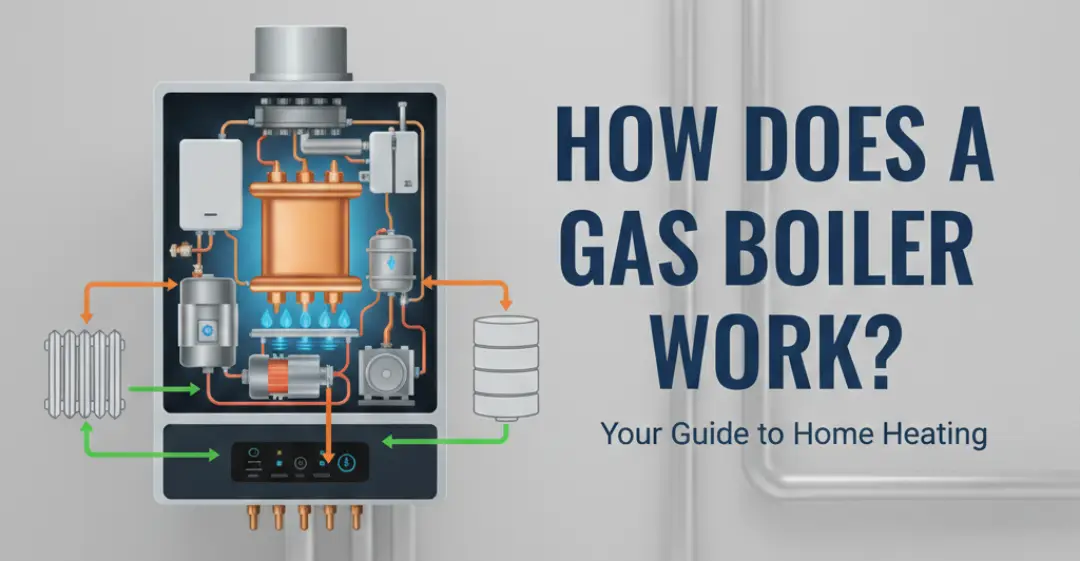
What are the key components of a gas boiler?
Getting a solid grasp of how a gas boiler functions starts with knowing its key parts and their roles. Here’s the quick rundown:
✔ Gas Burner
This is the fiery heart of your boiler — where gas ignites to produce the heat that keeps your home warm. It’s the spark that kicks everything into gear, turning fuel into cosy comfort.
✔ Heat Exchanger
Think of this as the heat transfer hero. It takes the intense heat from the burner and passes it to the water, all without mixing the two. That way, heat gets delivered efficiently without any fuss.
✔ Circulating Pump
The circulator that keeps the hot water flowing through your radiators and pipes, spreading warmth evenly across your home. No flow, no glow.
✔ Expansion Vessel
A pressure buffer that handles water expansion as it heats up. It stops dangerous pressure build-ups, keeping your system safe and sound.
✔ Venting Fan
This component safely blows out combustion gases, venting harmful fumes outside so your indoor air stays clean and safe.
✔ Exhausting Flue
The exhaust pipe vents gases produced during combustion safely outside, preventing dangerous buildup inside your home.
✔ Control Panel & Thermostat
Your boiler’s command center. They let you set the temperature and schedule, giving you control of your comfort on your terms.
✔ Printed Circuit Board (PCB)
It’s the brain of the operation that manages and coordinates all the components for optimal performance.
When any of these parts malfunction, homeowners often find themselves frantically searching for boiler repair experts. Understanding each element helps you better diagnose issues and appreciate the complexity behind a simple heat source.
How does a boiler work step by step?
Let’s break down the boiler’s operation in a simple, easy-to-understand way:
Step 1: The thermostat calls for heat
When your home needs warmth or hot water, the thermostat sends a signal to the boiler to turn on.
Step 2: Ignition of gas
The boiler’s burner ignites the gas, creating a controlled flame that produces heat.
Step 3: Heating the heat exchanger
Cold water from your supply flows into the heat exchanger, where it’s warmed up rapidly by the burner’s heat.
Step 4: Hot water circulates
A pump pushes the heated water through pipes to radiators or taps, delivering warmth where you need it.
Step 5: Safe exhaust of gases
Waste gases from combustion are safely expelled through the flue, keeping your home safe.
Step 6: System turns off when target temperature is reached
Once your desired temperature is achieved, the boiler stops heating until it’s needed again.
That’s the full cycle—efficient, automatic, and designed to keep your home warm and comfortable with minimal effort.
Expert tips: Proper maintenance of a gas boiler
Keeping up with regular boiler care ensures your system runs efficiently, cuts down on repair costs, and prevents unexpected breakdowns. Here’s what the experts advise:
- Schedule a professional boiler service once a year
- Bleed your radiators to boost heat circulation
- Keep boiler pressure within the recommended range
- Don’t ignore strange noises or error codes
- Address small issues early to avoid major repairs
Final words
Knowing how a gas boiler works puts you in the driver’s seat of your home heating. Whether it’s heating water or warming your whole house, gas boilers are smart, efficient systems designed for comfort.
With regular maintenance and prompt repairs, most boilers can keep running smoothly for years.
And remember, if something feels off, it’s always safer to call in a professional rather than guessing.
Your most asked questions about gas boiler systems
Will I have to replace my gas boiler after 2025?
No, you won’t be forced to replace an existing gas boiler. Current UK plans focus mainly on low-carbon heating in new builds. Existing boilers can still be repaired and replaced when necessary.
What is the average lifespan of a gas boiler?
Most gas boilers last about 10–15 years. With good maintenance, some can go even longer. So keep up with servicing.
How much does it cost to run a gas boiler for 1 hour?
On average, running a gas boiler costs between £0.50 and £1.50 per hour. The exact cost depends on your boiler’s efficiency, gas prices, and how well your home is insulated.
How often should boilers be serviced?
Typically, once a year. Regular annual servicing keeps your boiler running safely, efficiently, and makes sure it stays under warranty.
Do they check radiators during a boiler service?
Yes. Engineers usually check radiator performance, pressure levels, and overall system circulation as part of a standard service.
What is the most expensive part of a boiler?
The PCB (printed circuit board) is often the most expensive component to repair or replace. It manages critical functions, and its replacement involves specialised parts and labour.